

How Toronto’s Ravine Network Shapes Raccoon Movement
Raccoons find Toronto’s extensive ravine network a favorable environment. These eco spaces provide a connected grid, making the city a haven for these nocturnal creatures. This article explores how the ravine network shapes raccoon movement in the city.
The Role of Toronto’s Ravine Network
Categorized as a major geographical feature of Toronto, the ravine system supports a wide variety of wildlife. For raccoons, these ravines furnish a perfect network to support their behavior patterns. The ravines provide easy access to food, cover from predators and facilitate easy movement across the city.
Raccoon Activity
Raccoons are primarily nocturnal and are known for their opportunistic and adaptable nature. During the night, they can be seen moving around the city, mostly along the ravine networks, in search of food and shelter. Their activity is particularly high during warm weather.
Field reports show that the ravine network in Toronto makes their movement easy. Raccoons use these areas to move toward residential areas where the availability of food is higher due to household waste and gardens.
Ravine Network Influences Raccoon Distribution
The ravine network also influences the distribution of raccoons within the city. Large tracts of connected ravines may support larger raccoon populations. Areas of the city closer to ravines and parks can typically have more raccoon activity and sightings, as these spaces provide habitats for their survival.
The ravine network’s role in shaping raccoon movement is noticeable in their distribution across the city. Residents who are near the ravine system have noted an increase in raccoon sightings.
Raccoons and Human Interaction
The raccoons in Toronto often have interactions with residents due to their scavenging behavior. Raccoons can access unprotected trash cans, gardens, and even homes in search of food, which can lead to problems for residents.
Although they are often seen as a nuisance because of these interactions, it’s important to remember that raccoons are a vital part of Toronto’s biodiverse ecosystem. Their movement around the city is largely shaped by the environment and the availability of resources.
Toronto’s Approach to Raccoon-Mitigation Programs
Toronto’s management practices aim to lessen the interaction between raccoons and humans without causing harm to the animals. For instance, the city of Toronto introduced “animal-proof” green bins in 2016 to prevent raccoons from easily accessing food waste.
Conclusion
The ravine network in Toronto plays a significant role in shaping the movement of raccoons in the city. These ecosystems provide necessary resources, shelter, and pathways for raccoons to navigate throughout Toronto, influencing their distribution and interactions within the city. While they can pose challenges for residents, raccoons are an integral part of Toronto’s urban wildlife, and their presence is a testament to the city’s biodiversity.
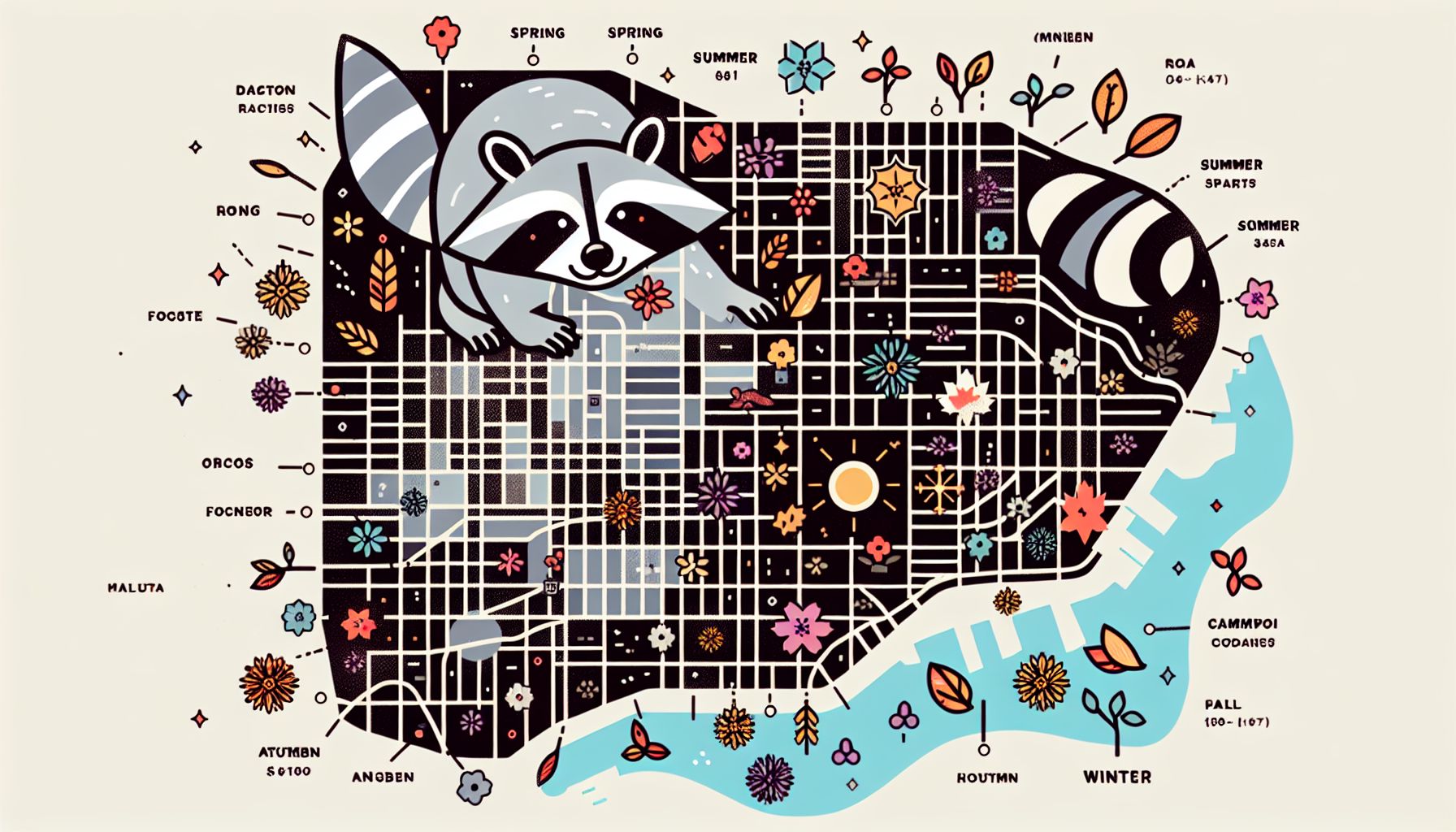
Seasonal Patterns in Raccoon Activity Across Toronto Neighbourhoods
Raccoons are a regular sight in the various neighbourhoods of Toronto. Given the adaptability of these animals, they have learned to thrive in the urban environment of this large Canadian city. However, their activities show distinct patterns according to the changing seasons, responding to shifts in weather, food availability, and breeding cycles. This article aims to explain these seasonal patterns and offer a better understanding of raccoon behaviour in Toronto.
Winter Dormancy and Scavenging
During the winter, raccoons in Toronto are less active. The colder temperatures cause these animals to go into a state of dormancy, which is not a full hibernation but a period of decreased activity. Still, there are times when they come out of their dens, primarily at night, to search for food. Mainly, these nocturnal creatures focus on accessible and energy-rich food sources like waste bins.
Spring Awakening and Breeding
As the harsh winter season shifts to spring, raccoon activity increases across Toronto. In response to the warming weather, these creatures start coming out from their dens more frequently and for more extended periods. This period also marks the commencement of their breeding season. Female raccoons may show altered behavioural patterns as they seek safe and secluded locations to establish nests. The areas that often attract them include attics, chimneys, and even under decks.
Summer Nights and Juvenile Activity
In summer, raccoon activity in Toronto is at its peak. The warm nights attract these animals to spend more time foraging and exploring their environment. During this period, the younger members of the raccoon population, which were born in the spring, start venturing out with their mothers. This increase in the number of active raccoons often leads to more frequent sightings in Toronto neighbourhoods.
Fall Preparation for Winter
When fall arrives, raccoons turn their attention to preparing for the upcoming winter. They start consuming more food to gain weight and store body fat. This period often leads to increased activity around human dwellings as raccoons search for substantial food sources. As winter approaches, these critters also seek warm and secluded spots to use as dens throughout the colder months.
Factors That Impact Seasonal Activity
Several factors influence the seasonal patterns of raccoon activity in Toronto. One of the most significant is the city’s urban environment, which provides an abundance of food and shelter, allowing raccoons to flourish. Additionally, Toronto’s climate plays a crucial role. The distinct seasons, with cold winters and warm summers, directly impact the behaviour and activity levels of these animals.
Misconceptions About Raccoon Activity
There are a few common misconceptions about raccoon activity in Toronto, primarily around the idea of absolute hibernation. While raccoons do reduce their activity levels in winter, they do not hibernate in the true sense. Additionally, many residents confuse increased summer activity as a population surge, whereas, in most cases, it’s the juvenile members of the species exploring their surroundings, making their presence more noticeable.
Understanding the patterns of raccoon activity in Toronto can help residents coexist with these adaptable creatures more harmoniously. Remember, raccoons play an essential part in Toronto’s urban ecosystem. Their behaviour is simply a response to the environment and the availability of food and shelter within it.

Raccoons as a Permanent Urban Species in Toronto
Introduction
One cannot discuss Toronto without acknowledging its sizable raccoon population. For residents and visitors alike, encountering these small mammals is a frequent occurrence. They have adapted to the cityscape, displaying an incredible level of sophistication and adaptability. This article investigates the presence of raccoons in Toronto, their activities, and their impacts on city life.
Raccoons in Toronto – An Urban Species
Raccoons are undeniably a part of Toronto’s urban wildlife. They treat the city as their personal playground, exploring gardens, and infiltrating trash bins in search of food. It’s not uncommon to spot these creatures making their homes in the nooks and crannies of buildings, indicating a clear adaptation to city living.
Understanding Raccoon Habits
Predominantly nocturnal creatures, raccoons in Toronto often start their activities at dusk and continue well into the night. They are driven by food and go to impressive lengths to locate sources of nourishment. City-dwelling raccoons demonstrate impressive problem-solving abilities, gaining access to enclosed spaces like garbage bins that hold their preferred meals. Their nightly hunts regularly bring them into contact with residents, and while these encounters are mostly peaceful, they can be a source of inconvenience, particularly when property gets damaged in the process.
Interaction with Humans
Interactions between Toronto’s residents and its raccoon population are unavoidable. These can range from amusing to problematic. Raccoons are known for their exploration and the resulting messes they can make, especially when interacting with garbage bins. That said, their integration into daily city life has added an element of charm and uniqueness to Toronto’s urban image, a fact that many residents acknowledge and respect.
Influence on Local Ecosystem
Raccoons significantly impact Toronto’s local ecosystems. Some consider their activity to be beneficial, as they help control pest populations, such as rodents. However, others see them as pests themselves, given the mess they create when scavenging for food. What is clear, however, is that their presence is a constant reminder of the intricate relationship between urban development and wildlife adaptation.
Regulatory Conventions
In terms of regulatory conventions regarding raccoons, Toronto adopts a balanced approach. The city promotes coexistence, discouraging harm to raccoons whilst also advising residents on limiting potential inconveniences by managing food waste appropriately and securing potential nesting spaces.
Constant Adaptation
Raccoons in Toronto exhibit impressive agility and adaptability. As the city changes and grows, so do their habits and habitats. This presents opportunities for continuous study and observation of how urban wildlife adjusts to anthropogenic influences, making them a fascinating subject in the study of urban ecology.
Concluding Thoughts
The presence of raccoons marks Toronto as a city teeming with life, not just human but also wildlife. Their adaptability and resilience are a testament to the wonders of nature even in the heart of a bustling metropolis. As urban dwellers, both people and raccoons need to find ways to live together, maintaining respect for the shared space they inhabit. The Toronto raccoon saga is a dynamic story of urban ecology, coexistence, and adaptation, one that continues to evolve and captivate those who experience it.

Raccoons are Great Climbers
Riverside park has been enduring some strange raccoon activity. They have had an attack of raccoons recently climbing all over a wall in the park. This is not too much of a surprise, except for the sheer number of raccoons, but raccoons are very good climbers. They are capable of scaling almost any non sheer material. They can even climb metal if it is painted by gripping the texture of the paint.
Raccoons love climbing things, trees, your house. They have even been known to scale great heights, being found on the tops of building and in strange places like electric towers. They seem to do it just for fun because many of the places they scale to don’t have food. Though they may be looking for birds nests.
If you have a raccoon scaling your house then you will need to deal with it. There are preventative measures you can take to keep raccoons off your property. They tend to come to your property for food and water. So if you cut off access to those things they are less likely to want to come to your property and will likely move on somewhere else. The key to getting rid of them is making sure your property is clean and clear. Get rid of garbage and detritus from your yard, anything a raccoon could hide in.
And maybe its time to tear down that hold shack in the back yard. You will also want to make sure to feed pets inside, pets drop food while they chew and that attracts raccoons. You can also make sure that whenever you or your children eat outside to always pick up food items dropped on the ground and to clean up the left overs right away. You should also store your garbage in a tightly sealed and locked container in the garage to prevent raccoons from accessing it.

How to Get the Raccoons Out From Under my Deck
Raccoons don’t like making their own dens. They prefer to find them. Dens that have been left by other animals like hollowed out trees or burrows. They will happily take on another animals space but their preference, especially in the city is to hang out on a home property. The property of a home is not like the property of other commercial locations. They lock their garbage and take care of their property. At home people tend to be more careless, I mean its your house right, have fun, do whatever you want. But you may find yourself face to face with a raccoon invasion if you are not careful. A lot of people love bbq and they tend to do it a lot and eat outside. Some people don’t even eat on a table and simply eat on paper plates that flop over.
People drop food all over the place and no one picks it up because it isn’t litter and it will be good for the lawn and all those things. But what it really does is attract raccoons to your property. So make sure to pick up all dropped food. Don’t feed your animals outside either because they make a serious mess and raccoons love pet food. You must, absolutely must, seal your garbage in a tight fitting container that locks and store it in your garage, this will prevent the animals from coming to your home.
Now if you have a raccoon living under your deck and you have already done all of the above and he wont leave then you will need to call a professional. At Raccoon Control our technicians can perform exclusion on your property and deck to seal the under area of your deck and then attach a one way door to allow the raccoon to leave but stops them from getting back in.

How Raccoons Survive The Winter
Raccoons are mammals and that means they are warm blooded and need warmth during the winter. Raccoons don’t always hibernate and when they do they do it in bursts. They prefer to stay active and the best way to stay active in the winter is to have a heated den, and it just so happens there’s an opening. In your attic.
Raccoons come to your attic because it has easy access to food on your property that allows it to find food easily without having to go to far from its new rental unit/den. They will often feed on pet food left out and garbage which they can knock over with relative ease and then tear apart and spread across your lawn in a way that could only be described as pretty amazing, for a small animal.
It really covers the lawn with the garbage, like a C.S.I. agent unloading the contents of a car on the side walk. They also love your leftovers and licking the meat off your bbq grill. All those dinners where children left their sandwich outside, or dropped food on the ground. That is how you get raccoons. They will swarm your property for a chance to taste the various delicacies.
And don’t forget about your coy pond, raccoons have been known to fish in them as coy is one of their favourite food. So yes, raccoons can stay active all winter, as long as they have your attic to live in. So make sure to clean up your yard and call in some professionals from Raccoon Control so we can come by and attach a one way door to safely and humanely remove the raccoon from your attic, no mus no fuss.

How Do Raccoons Get on Your Roof
How do raccoons get on your roof is not as important a question as why do raccoons want to get on your roof. Raccoons are aggressive territorial creatures that find a home and then refuse to give it up, so if they get into your attic the best way to get them out is to trick them with a one way door.
They get on your roof because they are very capable climbers. They can scale almost any material and can climb and jump trees to get to your roof or even just climb up the drain pipe. They can get onto your roof in dozens of way and their are few ways to stop them from climbing your building but you can stop them from getting up their easily. You can try making your drain pipe harder to climb with pigeon spikes that may deter the raccoon from trying to climb it.
You can also try putting aluminium collars around your trees bases to stop them from climbing and trimming back the branches to stop them from hopping one tree to another. This is not the only reason they are there though. They are also attracted to the garbage on the property which they are happy to tip over, rip open and spread across your property like a Jackson Pollock painting.
So seal all your garbage in a tight container and store it in your garage to keep it safe, you should also do the safe with your bbq if you tend to have dinner outside frequently. Food gets dropped all over the place and will attract raccoons. You should also not feed pets outside as they also spread food raccoons like to eat. If you follow these recommendations then you should have no raccoon issues on your property.

Are City Raccoons Better Survivors than Wild Raccoons
Wild raccoons and city raccoons are very different animals, comparing them is pointless but here we go anyway.
Wild raccoons are omnivores like their city based cousins. They will eat just about anything but have a very different diet from city raccoons. They tend to live on nuts and berries and the field mice they catch. They like fish and will sometimes try to catch one. They also eat leftovers from large carnivores and eat parts of the animal the carnivore was not interested in. Wild raccoons are also like their city counterparts in that they don’t make their own dens.
They find dens made and left by other animals. In the case of the wild, these are much harder to find and also more natural. The raccoon in the wild may live in an old burrow make by large rodents or a hollowed out tree. They are opportunity in that way. They will find whatever home they need and rarely build one themselves. As you can see wild raccoons live a different kind of life, they have the threat of predators which city raccoons do not have but in exchange they have much better food and water sources.
Raccoons in Toronto are far more opportunistic and will happily break into an attic or a basement to make its nest and it is happy to live mostly on garbage. There are a lot of differences as the city raccoon has no predators its not easily scared and unlike the wild raccoon it doesn’t run away from humans. They tend to approach humans for food and even try to steal food from humans and pets. They are wild animals in the wild but in the city they are far more like pests.